
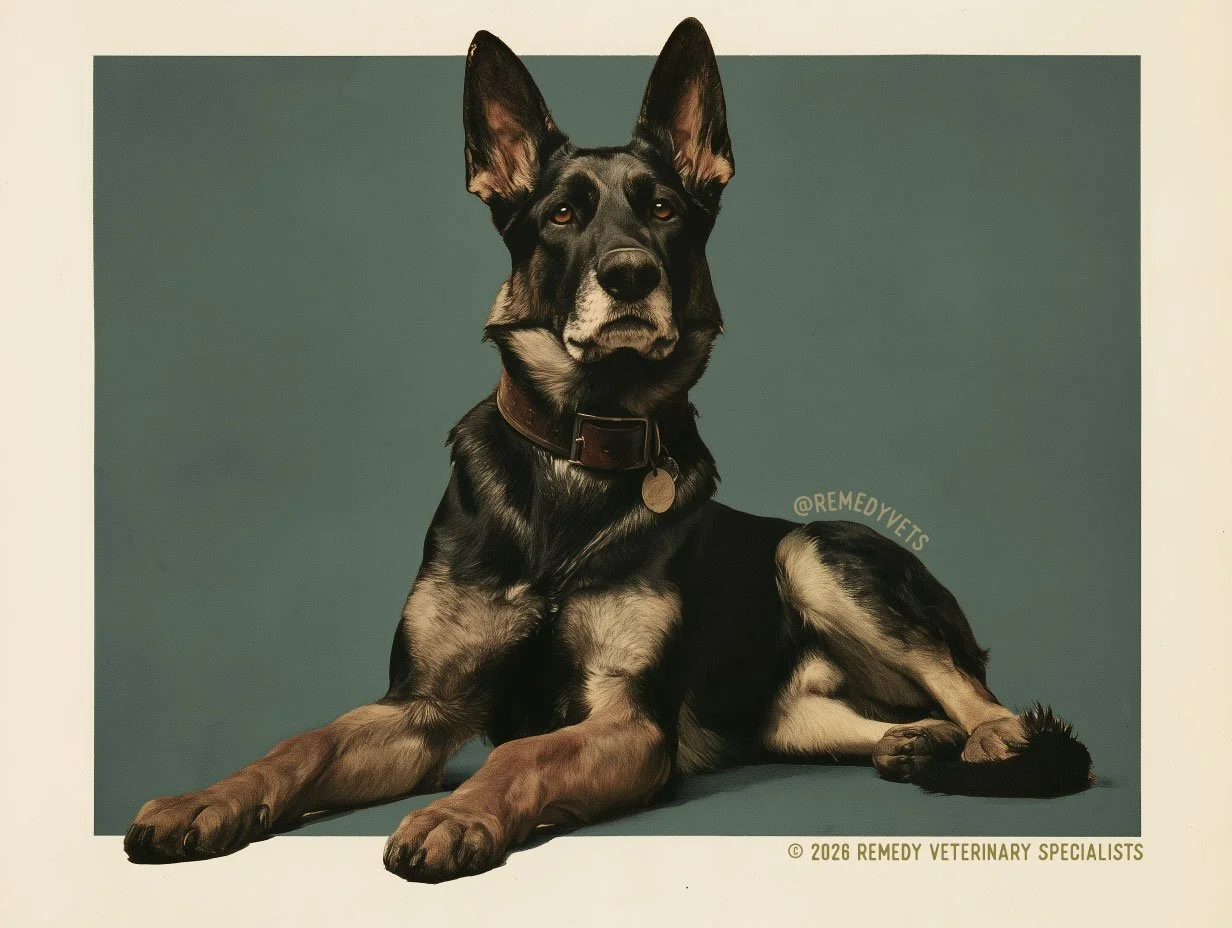
Degenerative Myelopathy in Dogs
By Dr. Carrie Jurney, DVM, DACVIM (Neurology) · Updated October 2026
Degenerative myelopathy (DM) is an incurable disease that causes a slow deterioration of the spinal cord and eventually leads to paralysis. There's no cure, but intensive physical therapy has been shown to slow it down.
If your older dog is starting to wobble, drag their back toes, or cross their back legs, Remedy's board-certified neurologists can find out whether it's DM or a treatable condition that looks similar. Call (415) 967-3303 or use the chat. No referral is needed.
Degenerative Myelopathy at a Glance
What it is: a slow, progressive disease of the spinal cord, similar to ALS (Lou Gehrig's disease) in people.
Who gets it: middle-aged and older dogs, most often German Shepherds, Boxers, Rhodesian Ridgebacks, Chesapeake Bay Retrievers, and Corgis.
Is it painful? No. Dogs with DM become weak and uncoordinated, but the disease itself doesn't hurt.
How fast it moves: the back legs usually weaken over about 12 months, and the front legs are affected 6 to 12 months after that.
Treatment: there's no cure. Physical therapy is the only treatment shown to slow it down. No supplement or diet cures DM, though some may support joints or general health.
Diagnosis: many other diseases look just like DM, and some of them are treatable. We recommend an MRI and a genetic test to tell them apart.
What Is Degenerative Myelopathy in Dogs?
In DM, nerve fibers in the spine die off. This process is similar to the human disease amyotrophic lateral sclerosis (ALS), also known as Lou Gehrig's disease. DM usually starts in the middle of the back and slowly spreads toward the head and tail. The cause of this nerve fiber death is unknown, but DM has been associated with a genetic defect (the SOD1 mutation). A test for this mutation exists, which we cover below.
Which dogs are at risk?
Degenerative myelopathy is usually diagnosed in middle-aged and older dogs. Any dog can develop DM, but German Shepherds, Boxers, Rhodesian Ridgebacks, Chesapeake Bay Retrievers, and Corgis appear to be at increased risk. When DM occurs in Corgis, it tends to appear later in life, often after age 11.
Healthy cord
Smooth, intact wiring

Cord with DM
Outer wiring breaking down

Degenerative Myelopathy Symptoms & Stages
In the early stages, dogs are uncoordinated in their back legs. They may trip over their feet or scuff their toenails. DM isn't painful. Paralysis often comes on gradually, but some dogs show a "stair step" pattern, where they're stable for long periods and then have sudden drops in function.
DM usually starts in the back legs and slowly moves forward. Every dog moves through these stages at their own pace. The back legs usually weaken over about 12 months, and the front legs are affected 6 to 12 months after that.
Back Legs Weaken Over About A Year, Then The Front Legs
The cards below show what each stage usually looks like and what can help. In the illustrations:
Gold shading means mild weakness
Rose shading means severe weakness or loss of use
DM itself doesn't hurt. If your dog seems to be in pain, something else may be going on, so let your vet know.
-
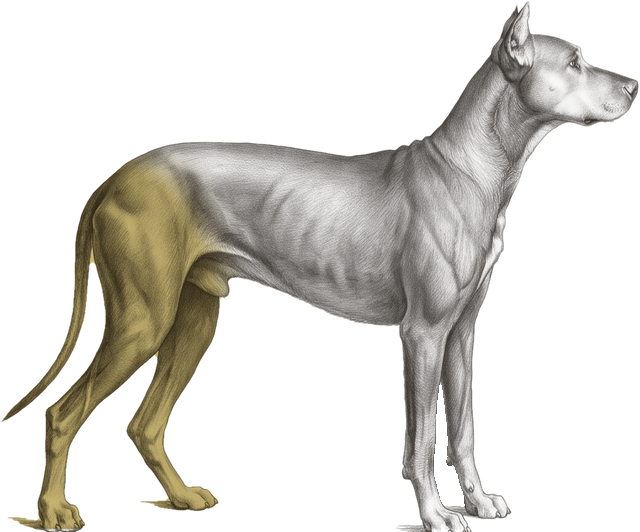
Stage 1: A wobbly back end
You may notice
Back legs sway or cross on turns
Toes scuff or knuckle under
Worn nails on the back feet
What helps
Daily walks and rehab exercises
Booties and rugs for grip
-
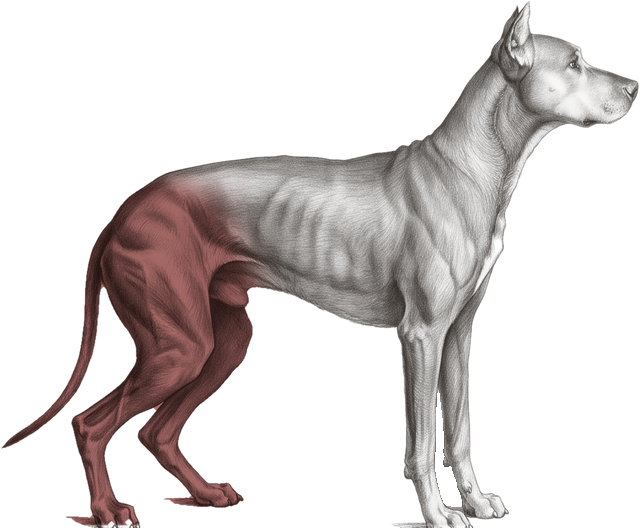
Stage 2: Back legs weaken
You may notice
Trouble standing up
Can't walk far without help
Slips and falls on smooth floors
What helps
A rear support harness
Rehab to keep muscles strong
A wheelchair when it's time
-
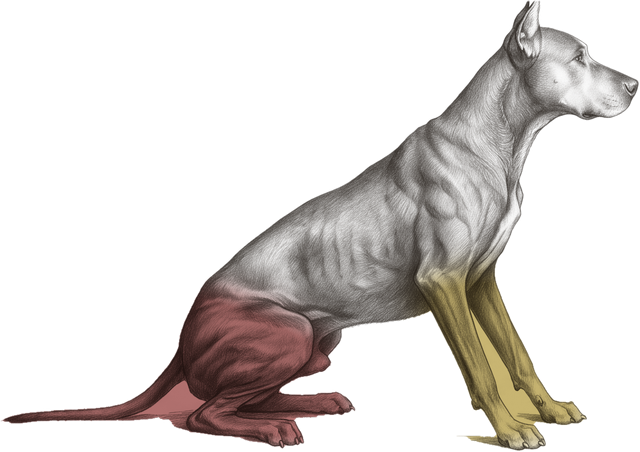
Stage 3: Back legs stop working
You may notice
No use of the back legs
Leaking urine or stool
Front legs start to tire
What helps
A wheelchair to stay active
A daily bladder care routine
Padded bedding to protect skin
-
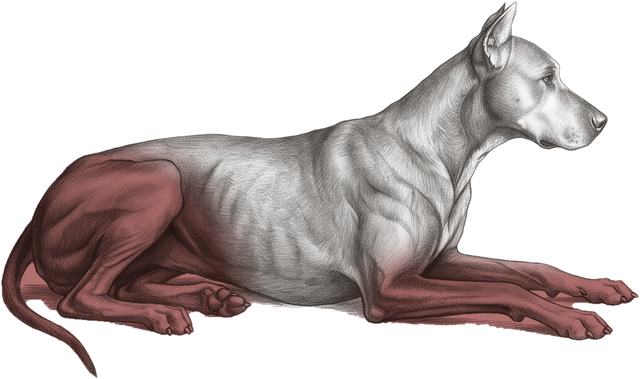
Stage 4: Front legs affected
You may notice
Weakness in all four legs
Hard to shift position alone
Needs help with most daily care
What helps
Comfort-focused care at home
Honest quality-of-life talks with your vet
Emergency Signs in Dogs With Degenerative Myelopathy
If your dog has any of the following signs, seek emergency veterinary care immediately:
Call (415) 967-3303, Monday through Friday, 8 a.m. to 5:30 p.m., or use the chat on our website.
-

Has trouble staying awake, or can't be roused
-

Has new or severe weakness in the front legs
-

Has trouble breathing
Is It Degenerative Myelopathy or Something Else?
It's a common misconception that all older dogs with incoordination and weakness have DM. Many diseases can look just like DM, such as a slipped disc (intervertebral disc disease, or IVDD), infection, a spinal cord tumor, or one of the numerous other spinal conditions that can look exactly like DM. Some of them are treatable. That's why it's important to look for other causes before deciding a dog has DM.
A few clues point away from DM and toward a problem that needs prompt attention:
-
DM isn't painful. A dog who cries out, hunches, or doesn't want their back or neck touched likely has something else, such as IVDD.
-
DM creeps in over months. Weakness that appears over hours or days needs to be seen quickly. See what to do if your dog can't walk.
-
DM usually starts in both back legs. Weakness on one side, or in the front legs first, points to another cause.

How Degenerative Myelopathy Is Diagnosed
Degenerative myelopathy can't be diagnosed by an exam alone, because many other diseases look just like it, and some of them are treatable. That's why we recommend both an MRI and a genetic test.
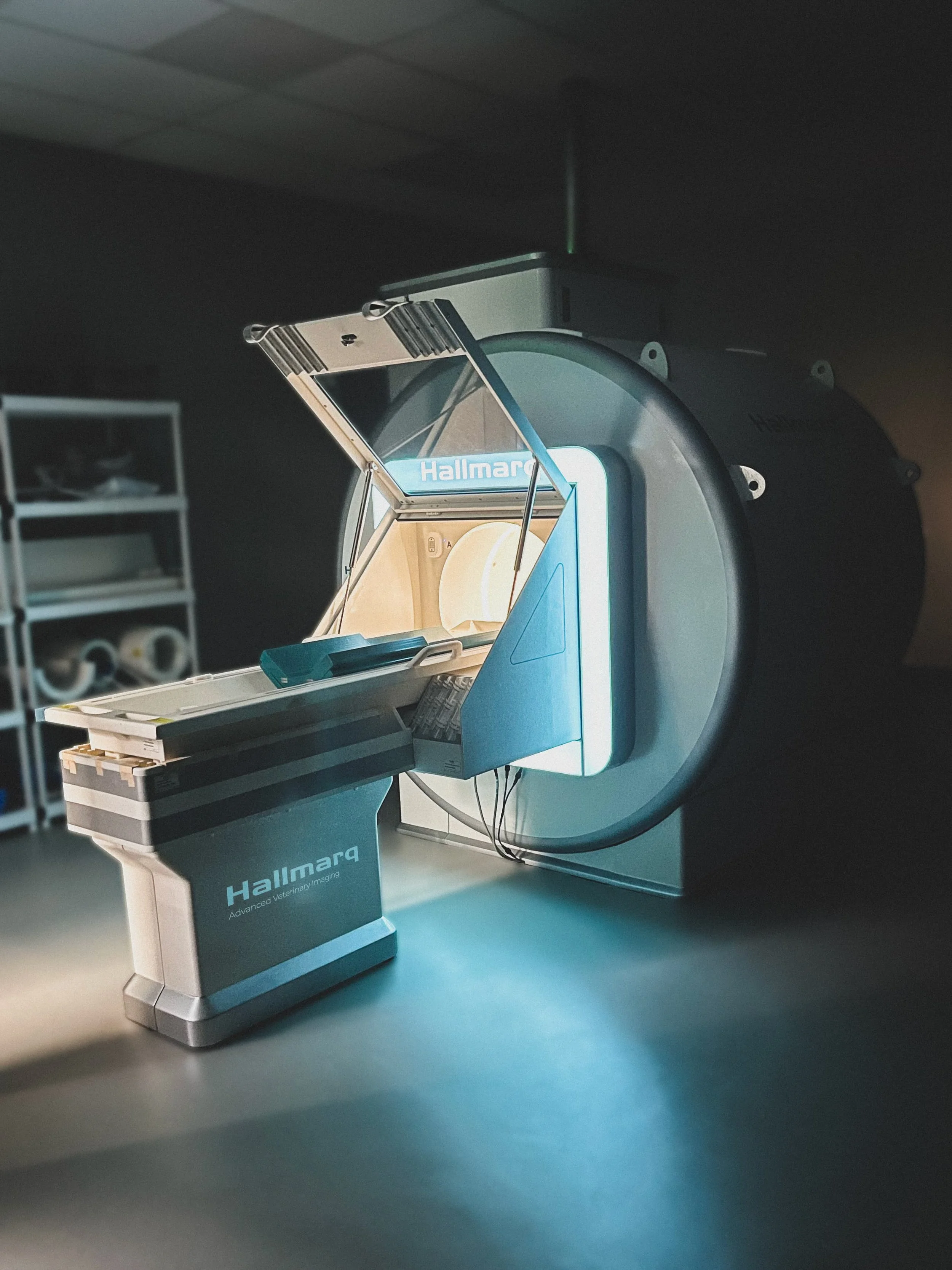
Remedy has an MRI on site, so imaging and the neurology consult can happen at the same hospital. Here is how we put the pieces together.
-
Step 1: Neurological exam
A neurologist watches your dog walk, checks reflexes, and tests how they place their paws. This shows where in the spine the problem is and whether the pattern fits DM.
-
Step 2: MRI of the spine
Recommended
DM changes are too small to see on MRI. We use it to find conditions that look like DM, such as a slipped disc or a tumor, and many of them are treatable. A spinal tap may be added. Remedy has an MRI on site.
Found a treatable cause? Then it isn't DM, and we treat that problem instead.
-
Step 3: Genetic test
Recommended
A simple cheek swab checks for the SOD1 gene mutation linked to DM. You can order the kit yourself from the Orthopedic Foundation for Animals (OFA), with no vet visit needed, or we can run it at your appointment.
OFA lists about 30 breeds with a proven link to DM. If your dog is one of them and you think they might have DM, testing is worth doing.
-
Step 4: A likely DM diagnosis
When nothing else explains the signs, the pattern fits, and the genetic test supports it, we diagnose DM and build a plan to keep your dog moving.
What Your Dog's DM Test Result Means
-
Normal (no copies)
Strongly suggests your dog does not have DM. Your veterinary team should keep looking for another cause of the weakness.
-
Carrier (one copy)
Also strongly suggests your dog does not have DM, so keep looking for other causes. Your dog can pass the mutation on to puppies, so spaying or neutering is recommended. Please also tell your breeder.
-
At risk (two copies)
Associated with DM, but doesn't confirm it. Not every at-risk dog develops DM, so other conditions still need to be ruled out, usually with MRI. Spaying or neutering is recommended, and please tell your breeder.
Treatment for Degenerative Myelopathy
Physical therapy
Physical therapy is the only treatment that has been shown to help dogs with degenerative myelopathy. Outcomes are best with higher intensity and more frequent sessions, so a structured program done as often as possible, ideally daily, is recommended.
Remedy's rehabilitation program, led by Sandy Gregory, RVT, VTS (Physical Rehabilitation), builds exercise plans you can do at home and fits wheelchairs and other assistive devices as your dog's needs change.
Supplements
Supplements marketed specifically for DM, or anything that claims to cure it, don't work. Physical therapy is the only thing shown to slow progression in dogs. That said, in ALS, the human disease DM most resembles, some supplements such as vitamin D and omega-3 fatty acids may help slow progression. And as your dog's back legs weaken, more weight shifts onto their joints, which can set them up for arthritis, so a joint supplement such as Adequan can be helpful. Our integrative care team is happy to review options with you.
Diet
Diets marketed as DM treatments haven't proven effective, and Remedy doesn't recommend them. If you'd like to explore diet therapy, a board-certified veterinary nutritionist can help create a balanced plan, and Remedy is happy to refer you.
Stem cell therapy
Stem cell therapy is sometimes discussed for DM, but there are only limited reports so far. The cells are grown from material collected in a surgical procedure and, for the best chance of success, must be injected around the spinal cord. Because it's experimental, invasive, and not yet proven, talk carefully with your veterinarian before considering it.
Quality of Life and When to Euthanize a Dog With Degenerative Myelopathy
Some families choose to stop when their dog can no longer walk under their own power, or when they become incontinent. Others choose a wheelchair at this stage. This decision is very personal, and there's no wrong answer.
A wheelchair can help, but it helps to know what it involves. Some dogs love their chair and some don't. Carts are special-ordered and fitted to your dog; our physical therapy team can help with that. Dogs can't stay in a wheelchair all day and need help getting in and out, which can be physically demanding with a large dog. Daily care at this stage also means helping your dog empty their bladder, keeping their skin clean and dry, checking for pressure sores, and watching for urinary infections. If you decide this isn't right for your dog or your household, don't feel guilty. That is a loving choice too.
If you choose to continue care after the back legs are paralyzed, DM eventually affects the front legs and then the brainstem. Remedy recommends euthanasia once your dog's front legs are significantly affected, before breathing and swallowing become difficult.
Questions that can help you decide:
Is your dog still eating, interested in family, and enjoying favorite things?
Can you keep them clean, dry, and free of sores?
Can you physically lift and move your dog safely?
Are the front legs getting weaker?
Are there more bad days than good days?
Our team is happy to talk through this with you, including what a wheelchair would involve for your dog.
Caring for a Dog With Degenerative Myelopathy at Home
Skin irritation & pressure sores
Wetness and pressure are the two most common causes of skin problems in a dog who can't walk, and both can worsen quickly if missed. After any urinary accident, use a waterless shampoo and soft towels to clean and dry the skin, paying close attention to the groin. Check for pressure sores every day, especially over the hips, shoulders, and elbows. Early sores may look like mild redness but can quickly become open wounds.
Urinary tract infections
Urinary tract infections are very common in pets with spinal problems. Each time your dog urinates, check the color and smell. If your dog urinates in grass, blot the spot with a white paper towel. Urine that's pink, red, brown, unusually dark, cloudy, or very foul-smelling is a reason to call your veterinarian.
Toenail & foot health
As incoordination progresses, many dogs with DM scuff their nails and injure their feet. Boots can help and are sold at stores like REI and through online pet mobility retailers. Fit varies, so choose a retailer with a good return policy, and make sure your dog spends at least half the day with boots off to prevent moisture and infection.
Degenerative Myelopathy FAQs
-
No. DM causes weakness and loss of coordination, not pain. If your dog seems painful, something else may be going on, such as a disc problem, and they should be examined.
-
It varies. The back legs usually weaken over about 12 months, and the front legs are affected 6 to 12 months after that. With a wheelchair and good home care, some dogs do well until the disease reaches the front legs. Physical therapy has been shown to slow progression.
-
No. There is no cure. Intensive physical therapy is the only treatment shown to slow it down.
-
Nothing marketed specifically for DM, or claiming to cure it, has been shown to work. Physical therapy is the only treatment shown to slow progression. Some supplements may still be worth discussing: in ALS, vitamin D and omega-3 fatty acids may help slow progression, and a joint supplement such as Adequan can protect joints that take extra load as the back legs weaken. Our integrative care team can review options with you.
-
Not necessarily. Two copies of the SOD1 mutation are associated with DM but don't confirm it, and many other spinal conditions look the same. Other causes need to be ruled out, usually with MRI.
-
They can look alike, but DM comes on slowly and isn't painful, while IVDD is often painful and can come on suddenly. Only testing, usually MRI, can tell them apart.
-
Many dogs do well in a wheelchair once their back legs are weak or paralyzed, and it can help them stay active. It's a personal decision that depends on your dog and your household. Remedy's rehabilitation team can help with fitting.
-
No. You can call Remedy directly at (415) 967-3303 or use the chat on our website, and we're happy to work with your regular veterinarian.

Ready to talk about your pet’s care?
You don’t need a referral to schedule with Remedy. Tell us what’s going on with your pet, and our team will help you choose the right appointment and explain what to expect, including costs, before anything is done.


Chat with us now using the chat button in the bottom right corner, or call (415) 967-3303.
Open 8 am–5:30 pm, Monday–Friday.